Custom Peptide Synthesis Brands: A Researcher’s Guide

Custom peptide synthesis brands are specialized service providers, typically CDMOs, CROs, or OEM manufacturers, that produce peptides to client specifications covering sequence, modifications, purity, and packaging for research or clinical use. Understanding what is custom peptide synthesis brands means recognizing that these companies differ significantly in synthesis technology, production scale, regulatory capability, and documentation standards. Researchers selecting a provider need to evaluate those operational differences directly, not rely on marketing language. This guide covers the full picture: workflows, synthesis methods, purity tiers, brand differentiators, and application contexts.
What are custom peptide synthesis brands and how are they defined?
Custom peptide synthesis brands are companies that manufacture peptides built to a client’s sequence and specification, rather than selling catalog compounds. The industry term for this category is contract peptide manufacturing, and it spans two broad tiers: discovery/research-grade services and GMP-grade manufacturing. Each tier carries different documentation requirements, quality standards, and pricing structures.
Research-grade providers produce peptides for laboratory use, typically with purity targets above 95% and basic analytical documentation such as HPLC traces and mass spectrometry data. GMP-grade providers operate under regulatory frameworks and produce peptides suitable for clinical trials and pharmaceutical development. The documentation scope at the GMP level includes batch records, release testing, and regulatory filings.

Peptide types produced across these brands include linear peptides, cyclic peptides, stapled peptides, disulfide-rich sequences, and modified analogs carrying labels, phosphorylation sites, or non-natural amino acids. The diversity of peptide architectures produced reflects the range of research applications these brands serve, from basic epitope mapping to advanced drug candidate development.
What operational workflows and production scales define these providers?
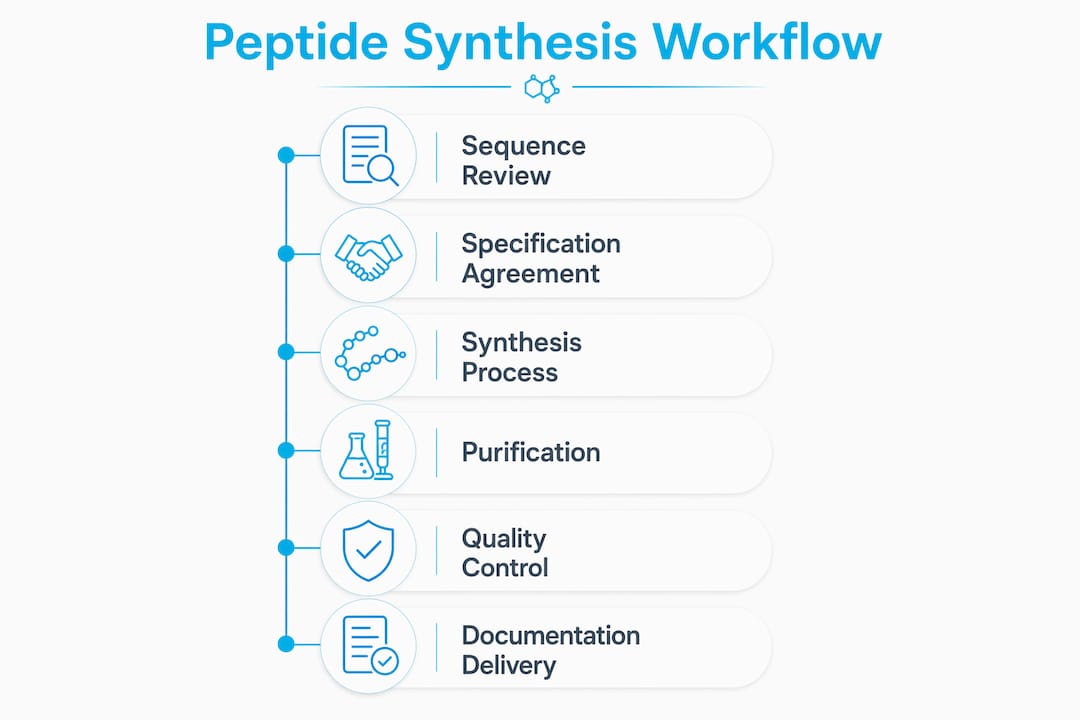
The standard production workflow begins with sequence confirmation, followed by agreement on purity targets and documentation scope, then synthesis, purification, analytical testing, lyophilization, and shipment. Each step introduces variables that affect lead time and final product quality. Researchers who treat the specification phase as routine often encounter rework delays or purity failures.
Lead times vary substantially by production scale. Research-grade peptides typically ship within 10–14 days. Pilot commercial runs require 14–21 days, standard commercial batches take 21–35 days, and large-scale runs extend to 35–60 days, sometimes split across multiple synthesis campaigns. These timelines assume a clean specification with no sequence-related synthesis challenges.
Production scales range from milligrams for early discovery work to over 100 grams for commercial supply. Providers like Peptifactory run syntheses across this full range and apply batch analytics including HPLC and LC-MS at each scale. That analytical coverage matters because purity profiles at milligram scale do not always predict outcomes at gram or multi-gram scale.
Sequence confirmation and specification agreement
Synthesis and resin cleavage
Purification by preparative HPLC
Batch analytics: HPLC purity, LC-MS identity confirmation
Lyophilization and vialing
Documentation package preparation and shipment
Pro Tip: Treat the quotation and specification phase as a technical negotiation, not an administrative step. Ambiguities in sequence notation, counter-ion preference, or purity measurement method create rework risk that adds weeks to delivery.
How do synthesis methods and purity tiers vary among providers?
Solid-phase peptide synthesis (SPPS) is the standard method across most brands. The Fmoc strategy dominates commercial production because it uses milder deprotection conditions than the older Boc strategy, reducing side reactions for most sequences. Boc-SPPS remains relevant for sequences containing acid-sensitive residues or for certain backbone modifications. Liquid-phase synthesis and hybrid approaches appear in specialized contexts, particularly for very short peptides or large-scale commodity production.
No single synthesis method suits every peptide. Brand selection should focus on the provider’s process controls relative to the sequence complexity and scale requirements, not on marketing claims about technology. A brand running Fmoc-SPPS with rigorous in-process monitoring will outperform one using the same method with poor resin loading controls.
Purity tiers across the industry break down as follows:
Purity tier Typical specification Common application Research grade >95% by HPLC In vitro assays, epitope mapping, proteomics Ultra-high purity >98% by HPLC Structural studies, reference standards GMP clinical grade Per ICH Q6A release specs IND-enabling studies, Phase I/II trials GMP commercial grade Full pharmacopeial testing Phase III and commercial supply
Documentation requirements scale with purity tier. Research-grade peptides typically ship with a certificate of analysis (COA) covering HPLC purity and MS identity. GMP-grade batches require full batch records, method validation data, and regulatory-ready documentation packages. Researchers moving a peptide candidate from discovery into clinical development need a provider capable of bridging both tiers.
Pro Tip: Request the full analytical testing package before placing an order, not just the COA template. Vendors standardized on HPLC and LC-MS testing reduce the lab’s burden for independent re-verification and speed up downstream assay development.
What key differentiators should researchers evaluate when choosing a provider?
Brand differentiation in custom peptide manufacturing is primarily operational. Price and purity tier are visible on a quote sheet, but the factors that determine whether a project succeeds are less obvious. Researchers evaluating peptide vendor qualification criteria should examine the following areas directly.
Regulatory compliance capability is the most critical differentiator for clinical-stage projects. Providers like Sinopep maintain GMP manufacturing capabilities with documented regulatory inspection history covering the U.S. FDA, MFDS, and NMPA. That inspection history is not a marketing credential. It reflects the operational discipline required to produce IND/NDA-ready documentation and to survive regulatory scrutiny during clinical development transitions.
Key differentiators to assess during vendor selection:
Synthesis capability for complex architectures: cyclic, stapled, disulfide-rich, and conformationally constrained peptides require specialized process controls that not all brands support
Customization depth: counter-ion options (acetate vs. TFA salt), pack size flexibility, aliquoting for multi-experiment use, and expedited production availability
Batch traceability: the ability to trace a finished batch back to raw material lots, resin batches, and in-process analytical records
Analytical testing standardization: vendors with fixed HPLC and LC-MS protocols reduce variability between batches and simplify cross-study comparisons
Technical support during specification: responsiveness during the quote phase predicts responsiveness when synthesis problems arise
Operational details in the specification process largely determine cost, lead time, and rework risk. Researchers should treat this phase as both technical and critical, not as a procurement formality.
How do different providers apply across research and drug development stages?
The appropriate provider type depends on the research stage and the regulatory trajectory of the peptide. Early discovery work requires speed, flexibility, and cost efficiency. Clinical development requires documentation depth, regulatory experience, and manufacturing consistency. Selecting a research-grade supplier for a clinical candidate creates a gap that is expensive to close later.
Applications by research stage:
Epitope mapping and immunology: research-grade linear peptides at >95% purity, milligram quantities, fast turnaround. Providers with peptide library synthesis capability are preferred.
Proteomics and mass spectrometry reference standards: ultra-high purity peptides with isotopically labeled residues. Requires vendors with stable isotope incorporation capability.
Pharmaceutical lead optimization: modified peptides including stapled, bicyclic, and PEGylated analogs. Requires providers with specialized synthesis capabilities for complex architectures.
IND-enabling studies: GMP-grade synthesis with full analytical package, stability data, and regulatory documentation. Providers with FDA inspection history reduce transition risk.
Commercial supply: large-scale GMP manufacturing with validated processes, pharmacopeial testing, and supply chain redundancy.
Scale considerations are not just about quantity. Moving from a 50 mg research batch to a 10 gram GMP batch involves process transfer, method validation, and regulatory filing. Providers that have completed this transition for other clients carry institutional knowledge that reduces risk for new programs. Sourcing high-quality peptides at each stage requires matching the vendor’s actual capabilities to the project’s actual requirements, not the vendor’s marketing claims.
Documentation and regulatory support become non-negotiable at the clinical stage. GMP-trajectory vendors with regulatory inspection history and IND/NDA support capability reduce risk when progressing from early-phase research to commercialization. Researchers who delay this evaluation until after lead selection often face costly supplier transitions.
Key Takeaways
Custom peptide synthesis brands differ most critically in synthesis method controls, purity documentation depth, regulatory compliance history, and support for complex peptide architectures.
Point Details Brand tiers matter Research-grade and GMP-grade providers have fundamentally different documentation and quality standards. Specification phase is critical Ambiguities in sequence, purity, or counter-ion preference drive rework risk and extend lead times. Synthesis method fit Fmoc-SPPS dominates, but complex peptides require vendors with specialized process controls beyond standard linear synthesis. Regulatory history is verifiable Providers with documented FDA, MFDS, or NMPA inspection history carry lower risk for clinical-stage programs. Scale transition requires planning Moving from research to GMP scale involves process transfer and method validation, not just larger batch sizes.
What I’ve learned from working with custom peptide synthesis providers
The most consistent mistake researchers make is treating the vendor selection process as a procurement exercise rather than a technical one. A quote sheet shows price and purity tier. It does not show whether the vendor has successfully synthesized a disulfide-rich 40-mer, how they handle failed syntheses, or whether their COA reflects a single HPLC run or a full analytical package.
The specification phase is where projects succeed or fail. I have seen programs delayed by weeks because a researcher submitted a sequence without specifying the counter-ion, the salt form, or the acceptable purity measurement method. The vendor produced a technically compliant product that did not meet the actual assay requirements. That rework cost more in time than the original price difference between vendors.
Regulatory compliance capability is frequently underweighted until it becomes urgent. Researchers working on early-stage discovery often select the fastest, cheapest provider without considering whether that provider can support a future IND filing. When the peptide advances, the team faces a full supplier transfer, including revalidation and regulatory notification. Choosing a provider with GMP capability from the start, even for research-grade orders, preserves optionality.
Batch traceability and analytical standardization are the two quality indicators I weight most heavily. A vendor that can trace a finished batch back to raw material lots and provide consistent HPLC and LC-MS data across batches is operationally reliable. One that cannot is a liability in any reproducibility-dependent research program.
— Sam Levin
Research-grade peptides with full documentation from PeptidesFromChina
Products are subject to the manufacturer’s applicable quality-control procedures and specifications. Manufacturer-side analytical documentation may be available depending on the product and batch. PeptidesFromChina is not an independent analytical testing laboratory. The catalog covers signaling peptides, longevity compounds, GLP-1 agonists, and mitochondrial compounds.
Products are subject to the manufacturer’s applicable quality-control procedures and specifications. Manufacturer-side analytical documentation may be available depending on the product and batch. PeptidesFromChina is not an independent analytical testing laboratory. Researchers can browse the catalog and confirm current availability and document availability during order processing. Learn more: full peptide catalog. Learn more: KPV. Learn more: Epithalon.
FAQ
What is custom peptide synthesis in the context of research?
Custom peptide synthesis is the contract production of peptides built to a researcher’s sequence and specification, covering modifications, purity, and packaging. It differs from catalog peptide purchasing because every batch is produced to order.
How do I choose between research-grade and GMP-grade peptide providers?
Research-grade providers suit discovery and in vitro work where speed and cost matter most. GMP-grade providers are required for IND-enabling studies and clinical supply, where regulatory documentation and inspection history are non-negotiable.
What purity level is standard for research peptides?
Research-grade peptides are typically specified at greater than 95% purity by HPLC. Ultra-high purity grades at greater than 98% are used for reference standards and structural studies.
Why does the specification phase affect lead time and cost?
Operational details in the specification process determine synthesis complexity, purification requirements, and documentation scope. Incomplete specifications require clarification rounds that add days or weeks before synthesis begins.
What peptide architectures require specialized synthesis providers?
Complex peptide designs including stapled, bicyclic, disulfide-rich, and conformationally constrained peptides require vendors with process controls beyond standard linear Fmoc-SPPS. Not all brands support these architectures reliably.