Certificate of Analysis Review Checklist for QA Teams

A COA review must first prove traceability before any numeric result is trusted. The lot number on the document must match the physical label and the purchase order; the issuing laboratory must be independently verifiable; and the critical analytes for your specification must appear with method references and numeric results, not qualitative “conforms” statements. Without those three anchors, the numbers in the test table are unverifiable regardless of how clean they look.
Three checks to run at acceptance, in order:
Lot/PO/label match. Compare the lot or batch number on the COA against the label on the physical container and the purchase order line item. A single-character mismatch is grounds for a hold.
Lab identity and accreditation. Confirm the issuing laboratory’s name, address, and accreditation status (ISO/IEC 17025 or GLP, where applicable) before reading any result. An unverifiable lab renders the document unreliable.
Methods and critical analytes present. Confirm that each analyte required by your specification appears in the test table with a named method (HPLC, GC, ICP-MS, LC-MS, or equivalent), a numeric result, units, and a specification limit.
Quick disposition rules at first sight:
Pass: All three checks clear; all critical analytes within spec; lab accreditation confirmed; dates consistent.
Hold: Any single check is unclear or borderline; lot match is ambiguous; one analyte is near the specification limit; test date is older than your retest interval.
Reject: Lot number absent or mismatched; lab unverifiable; critical analyte missing or out of specification; document unsigned or undated.
If a hold is triggered, place the material in quarantine immediately, contact the supplier’s QA representative in writing requesting the original raw data (chromatograms, mass spectra, or instrument printouts), and document the hold in your LIMS or batch record with a timestamp. Do not release conditionally until the gap is resolved in writing.
Key Takeaways
A COA review is only as reliable as its traceability anchors: lot match, lab identity, and method-linked numeric results are the three non-negotiable checks before any result is trusted.
Point Details Traceability first Confirm lot/batch number matches the label and PO before reading any analytical result. Lab verification is non-negotiable Search A2LA or NVLAP to confirm the issuing lab’s accreditation scope covers the tests listed. Request raw data at limits When any result falls within 10% of a specification limit, request the chromatogram or MS spectrum before release. Dates must be internally consistent Test date must follow production date; issue date must follow test date; retest date must not be exceeded. PeptidesFromChina provides traceable documentation Procurement teams sourcing research peptides can request synthesis batch codes and independent MS verification data directly.
Table of Contents
What Does a Complete Certificate of Analysis Review Checklist Cover?
How to Use This Checklist in an Incoming Inspection Workflow
How to Read a COA: A Field-by-Field Guide
What Do the Analytical Methods on a COA Actually Tell You?
Red Flags That Should Stop a COA Release
Per-Lot Confirmatory Checks and When to Trigger Them
How Dates, Versioning, and Traceability Affect COA Validity
Disposition Decisions, Documentation, and CAPA Follow-Up
Annotated Specimen COA with Key Field Callouts
How to Adapt the Checklist Across Industries
Peptide-Specific COA Considerations
A QA Reviewer’s Practical Habits for Fast, Reliable Reviews
Research-Grade Peptides with Transparent COA Documentation
Sources
What Does a Complete Certificate of Analysis Review Checklist Cover?
A structured COA review checklist maps every document field to a specific verification action, an expected evidence type, and a pass/hold/reject criterion. The table below is a copy-paste template for incoming inspection. Add reviewer initials, review date, and disposition code at the bottom of each completed form.
# Check Item What to Verify Expected Evidence Pass Criterion Hold Criterion Reject Criterion 1 Lot/batch number Matches label, PO, and packing list exactly Physical label + PO Exact match Partial match or illegible Absent or mismatched 2 Product name and grade Name and grade match PO and specification PO, approved spec Exact match Minor formatting difference Different product or grade 3 Manufacturer/supplier identity Legal name, address, and contact present COA header All present Address incomplete Name absent or unverifiable 4 Issuing laboratory identity Lab name, address, and accreditation number COA header Verifiable + accredited Accreditation not confirmed Lab not found or anonymous 5 Lab accreditation scope ISO/IEC 17025 or GLP scope covers tests listed Accreditation body database Scope confirmed Scope not checked Scope excludes listed tests 6 Specification version COA references the current approved spec version Approved spec document Current version cited Version not cited Obsolete version cited — Test date vs. production date Test date is after production date; within retest interval COA dates Consistent Gap unexplained Test predates production — Issue date vs. test date Issue date is on or after test date COA dates Consistent Same-day (verify) Issue predates test 9 Expiry/retest date Retest or expiry date present and not exceeded COA + label Within date Approaching limit Expired 10 Analytical method per analyte Named method (HPLC, GC, ICP-MS, etc.) with method ID or SOP reference Test table Method ID present Generic name only No method listed 11 Result vs. specification Each result falls within the stated acceptance limit Test table All within spec One result near limit Any result outside spec 12 Units and reporting limits Units match specification; LOQ/LOD stated for trace analytes Test table Units match; LOQ stated Units ambiguous Units absent or wrong 13 Qualitative statements “Conforms” or “ND” accompanied by numeric context or LOQ Test table Numeric LOQ present LOQ absent but plausible Bare “conforms” with no data 14 Analyst signature and date Analyst or authorized signatory name, signature, and date COA footer Signed and dated Printed name only Unsigned 15 QA/approver signoff QA manager or authorized releaser signature COA footer Present Missing but supplier confirms Absent — Raw data availability Chromatograms, spectra, or instrument printouts available on request Supplier file Available Not yet requested Refused
Step-by-step run order for incoming inspection:
Check lot/batch number against label and PO (items 1–2).
Verify lab identity and pull accreditation scope from the relevant accreditation body database (items 4–5).
Confirm specification version and date consistency (items 6–9).
Review each analyte row: method, result, units, and spec limit (items 10–13).
Confirm signatures and approver signoff (items 14–15).
Record reviewer initials, review date, and disposition code (Pass/Hold/Reject/Conditional Release).
A summary COA is sufficient for routine, low-risk materials from a qualified supplier with a clean history of at least three consecutive passing lots.*
How to Use This Checklist in an Incoming Inspection Workflow
The checklist above does not operate in isolation. It connects to receiving, QA, EHS, and procurement touchpoints, each with a defined role and a specific sign-off point.
Roles and responsibilities:
Receiving: Confirms physical lot number, label, and packing list match before the shipment enters the warehouse. Flags visible damage or temperature excursions. Does not release material.
QA reviewer: Executes the full checklist, assigns a disposition code, and signs the review record. The only role authorized to release or reject.
EHS: Reviews SDS alignment with the COA (especially for hazardous chemicals) and confirms storage conditions match the material’s classification.
Procurement: Provides the approved PO and specification version. Receives written notification of any hold or rejection and initiates supplier communication.
Risk-based prioritization matrix:
Not every incoming lot warrants the same depth of review. A practical risk matrix scales the checklist effort:
Low risk (established supplier, three or more consecutive passing lots, non-critical material): Items 1, 2, 4, 11, and 14 at minimum. Full checklist quarterly or on any change.
Medium risk (new supplier, critical material, or first repeat order after a gap): Full checklist every lot. Request method IDs for all critical analytes.
High risk (first order, injectable or sterile material, peptide active, or material near a regulatory threshold): Full checklist plus confirmatory in-house testing or third-party verification. Raw data required before release.
Integration with purchase orders, labels, SDS, and batch records:
The COA review record should be filed alongside the PO, the label photograph or scan, the SDS, and any in-house test results in a single batch record package. This package is what an auditor will request under 21 CFR Part 211 subpart E, which requires retention of laboratory records and test results relevant to batch release.
Timing and conditional release:
Complete items 1–5 (traceability and lab identity) before the shipment leaves the receiving dock.
Complete the full checklist within one business day of receipt.
If a hold is triggered on a non-critical item (e.g., spec version not cited but supplier confirms verbally), issue a conditional release with a 72-hour window to receive written confirmation before the material enters production.
Never issue a conditional release for a lot/batch mismatch, an out-of-specification result, or an unverifiable laboratory.
How to Read a COA: A Field-by-Field Guide
A COA typically contains four zones: the header (identity and traceability), the test table (analytical results), the methods section (how tests were run), and the footer (signatures and dates). Each zone has specific fields that require active verification, not passive reading.
Header fields:
Product name: Must match the approved specification and PO exactly, including grade designation (e.g., “research grade,” “USP,” “technical grade”).
Lot/batch number: The primary traceability anchor. Cross-reference against the physical label and PO before reading anything else.
Production date and manufacture site: Confirms the material is not pre-dated and identifies the origin facility.
CAS number (where applicable): Verify against your specification for chemical identity.
Test table fields:
Parameter: The analyte or property being tested (e.g., purity, water content, heavy metals, microbial count).
Method: The analytical procedure used. A named method with an ID (e.g., AOAC 2002.02, USP <621>, HPLC-UV) carries more weight than a generic label like “HPLC.” AOAC official methods provide validated references that labs cite on COAs; seeing a specific AOAC or USP method ID increases confidence in result comparability.
Result: The measured value. Must be numeric for quantitative tests. Qualitative results (“conforms,” “passes”) are acceptable only for tests where a numeric result is not technically applicable (e.g., appearance, odor).
Units: Must match the specification exactly. Common pitfalls: μg/g and ppm are numerically equivalent in most matrices, but mg/kg and mg/L are not interchangeable without density data. Confirm the basis (per gram, per mL, per serving, dry weight vs. wet weight) before comparing.
Specification limit: The acceptance criterion. Confirm this matches the current approved specification version, not a prior revision.
Interpreting qualitative and limit statements:
“ND” (not detected): Acceptable only when the LOD (limit of detection) is stated. Without a stated LOD, “ND” is unverifiable.
“<LOQ” (below the limit of quantitation): Acceptable when the LOQ value is stated and is below the specification limit. If the specification limit is 0.1 ppm and the LOQ is 0.5 ppm, the result does not confirm compliance.
“Conforms”: Acceptable for appearance or organoleptic tests. For any quantitative parameter, a bare “conforms” without a numeric result should trigger a request for the underlying data, consistent with FDA data-integrity guidance on ALCOA+ expectations.
When method IDs are missing:
Contact the supplier’s QA contact in writing and request the SOP reference or method ID for each affected analyte. Do not accept “proprietary method” as a complete answer for a critical analyte. If the supplier cannot provide a method reference, escalate to a hold and consider third-party confirmatory testing.
What Do the Analytical Methods on a COA Actually Tell You?
The method listed next to each result tells you what the instrument measured and how reliably it can distinguish the target analyte from interferences. A method name alone is not sufficient; the version, column type, and detection mode matter for critical analytes.
Quick method reference:
HPLC (High-Performance Liquid Chromatography): Used for identity, purity, and potency of organic compounds including peptides and small molecules. UV detection is standard; confirm the detection wavelength is appropriate for the analyte. HPLC-UV cannot confirm molecular identity on its own for complex molecules.
GC (Gas Chromatography): Used for residual solvents, volatile organic compounds, and fatty acid profiles. Confirm the column type and detector (FID, MS) are appropriate for the analyte class.
ICP-MS (Inductively Coupled Plasma Mass Spectrometry): The standard for trace elemental analysis and heavy metals. Confirm the elements tested match your specification (e.g., Pb, Cd, As, Hg for most regulated products).
LC-MS or LC-MS/MS: Provides both chromatographic separation and mass confirmation. For peptides, this is the minimum standard for identity confirmation. Intact mass plus MS/MS fragment ions constitute meaningful identity evidence.
Karl Fischer titration: Used for moisture/water content. Confirm whether the result is reported on a dry-weight or wet-weight basis.
Microbiology (total aerobic count, yeast/mold, pathogens): Confirm the method references a recognized standard (USP <61>/<62>, AOAC, or equivalent) and that incubation conditions and reporting units (CFU/g or CFU/mL) match your specification.
ICH quality guidelines describe internationally accepted expectations for specification setting and method validation that inform what a well-documented COA method section should contain.
When a method summary is sufficient vs. when to request full SOPs:
A method name with a recognized reference (USP, AOAC, EP) is sufficient for routine materials from qualified suppliers. Request full SOPs or method validation data when: the method is described as “in-house” with no external reference; the analyte is a critical quality attribute (identity, potency, or a safety-relevant impurity); or the result is near a specification limit.
Method-related red flags:
Instrument type omitted (e.g., “HPLC” with no column, detector, or wavelength information for a critical analyte).
LOQ or LOD not stated for trace-level analytes.
Non-standard methods with no validation summary available.
Method version not cited when the method is known to have multiple revisions.
For peptide identity specifically, HPLC-UV purity alone is insufficient. Molecular weight confirmation by MS is the minimum acceptable evidence for research-grade peptides. For deeper guidance on interpreting peptide-specific analytical testing results, the method section of the COA is the first place to scrutinize.
Red Flags That Should Stop a COA Release
A COA that passes a casual reading can still carry serious traceability or integrity problems. The following patterns are the most common and highest-risk signals that warrant a hold or rejection before any result is trusted.
Document-level red flags:
Lot number absent, illegible, or formatted differently from the physical label.
Product name or grade does not match the PO or approved specification.
Lab name is generic, misspelled, or returns no results in an accreditation database search.
Identical numeric results across multiple batches (e.g., purity reported as exactly 99.—% on every lot for 12 months). Real analytical variation produces variation in results; perfectly repeated values suggest transcription rather than measurement.
Test date is earlier than the production date.
Issue date is earlier than the test date.
Document is unsigned or carries only a printed name with no signature.
“Conforms” used for quantitative parameters with no numeric result or LOQ.
Laboratory verification steps:
Verify the issuing lab by searching the relevant national accreditation body database. In the United States, A2LA (American Association for Laboratory Accreditation) and NVLAP (National Voluntary Laboratory Accreditation Program) publish searchable scope-of-accreditation records. ISO/IEC 17025 is the internationally recognized standard for testing and calibration laboratory competence; confirm the lab’s scope covers the specific tests listed on the COA, not just a general chemistry category. If the lab cannot be found in any accreditation database, contact the supplier for a copy of the lab’s accreditation certificate and verify its authenticity directly with the issuing body.
Escalation rules:
Pause release immediately on any document-level red flag. Place the lot in quarantine and document the hold with a timestamp.
Request third-party testing when the supplier cannot provide raw data within 48 hours or when the lab cannot be verified.
Notify procurement and QA management in writing when a lot is rejected or when a supplier produces two or more holds within a rolling 12-month period.
Initiate supplier requalification when red flags are systemic rather than isolated.
For supplier verification and qualification workflows that connect COA review to broader vendor management, a structured vendor scorecard helps track hold frequency and escalation history over time.
Per-Lot Confirmatory Checks and When to Trigger Them
Supplier COA data is a starting point, not a final answer for high-risk materials. The decision to run in-house confirmatory testing should follow a defined decision tree rather than ad hoc judgment.
First order from any supplier: Run confirmatory identity and purity testing regardless of COA quality. This establishes a baseline and validates the supplier’s analytical claims before the relationship scales.
Critical analyte result within 10% of the specification limit: Run in-house confirmation for that analyte. A result of 98.2% against a 98.0% minimum leaves no margin for measurement uncertainty.
New product or new formulation from an existing supplier: Treat as a first order for confirmatory purposes.
High-risk use (injectable, sterile, or human-adjacent research application): Sterility and endotoxin testing in-house or at a qualified contract lab, every lot.
Repeat buys from a qualified supplier with three or more consecutive passing lots and no holds: COA review alone is sufficient for low-risk materials; schedule periodic confirmatory testing (e.g., one lot per quarter) to maintain the qualification.
Recommended confirmatory tests by risk type:
Peptide identity: LC-MS or LC-MS/MS for intact mass and fragment ion confirmation. HPLC-UV purity as a secondary check.
Small-molecule potency: HPLC with a validated method matched to the analyte class.
Heavy metals: ICP-MS for the full elemental panel required by your specification.
Sterility and endotoxin: USP <71> sterility and USP <85> bacterial endotoxins test for any injectable or sterile material.
Residual solvents: GC-headspace per USP <467> or equivalent.
Documentation for confirmatory testing:
Chain-of-custody records must accompany any sample sent to a contract lab. Retain a split sample in-house. File the confirmatory test report alongside the supplier COA in the batch record. When confirmatory results differ from the supplier COA, initiate a formal investigation before releasing or rejecting the lot. For procurement teams sourcing COA-verified peptides wholesale, confirmatory testing protocols should be defined in the supplier agreement before the first order is placed.
How Dates, Versioning, and Traceability Affect COA Validity
A COA can carry accurate results and still be invalid for release if the date relationships are inconsistent or if the specification version it references has been superseded.
Date checks:
Test date must be after the production date. A test date that precedes the stated manufacture date indicates a documentation error or a pre-dated document.
Issue date must be on or after the test date. An issue date earlier than the test date suggests the document was generated before testing was complete.
Retest or expiry date must not be exceeded at the time of receipt. If the material arrives within 30 days of its retest date, flag it for expedited review and confirm storage conditions have been maintained.
For food and ingredient materials, FSMA traceability requirements reinforce that lot-linked records including test dates must be retained and retrievable.
Specification version control:
The COA must reference the specification version that was current at the time of manufacture and testing. If your organization has updated its specification since the lot was produced, confirm whether the old specification limits are still acceptable for the intended use. Document the rationale for accepting a COA against a prior spec version in the batch record.
Electronic record integrity:
COA PDFs stored in an ERP or LIMS are subject to 21 CFR Part 11 controls where electronic records are used for regulatory purposes. This means audit trails, access controls, and electronic signature controls must be in place. File naming conventions should include lot number, product code, and review date to support retrieval. Retention timelines for batch records under 21 CFR Part 211 are a minimum of one year past the product’s expiry date, or three years from the date of manufacture, whichever is longer.
Investigating date inconsistencies:
When dates are inconsistent, open a formal deviation record. Request the original instrument run logs from the lab (timestamped, not transcribed) to confirm the actual test date. Do not release the lot until the inconsistency is resolved in writing.
Disposition Decisions, Documentation, and CAPA Follow-Up
Every COA review ends with a documented disposition decision. The decision must be traceable, signed, and linked to the specific evidence that supported it.
Disposition flow:
Pass → full release: All checklist items clear, all results within spec, lab verified, signatures present. QA reviewer signs the release record and files the batch package.
Marginal → conditional release with monitoring: One or more results near the specification limit but within acceptance criteria; lab verified; no other red flags. Conditional release requires a documented rationale, a defined monitoring plan (e.g., confirmatory test on next lot), and QA manager countersignature.
Fail → reject and investigate: Any out-of-specification result, unverifiable lab, lot mismatch, or unsigned document. Rejection requires a written non-conformance report, supplier notification, and CAPA initiation if the failure is systemic.
Required documentation for each disposition:
Reviewer name, signature, and date.
Checklist items reviewed and evidence referenced.
Disposition code and rationale.
For holds and rejections: description of the non-conformance, corrective action requested from the supplier, and timeline for resolution.
Non-conformance report language (template):
“Lot [number] of [product name] received [date] has been placed on hold/rejected due to [specific finding]. The supplier is requested to provide [specific evidence or corrective action] by [date]. This lot will not be released until the non-conformance is resolved in writing.”
CAPA triggers:
Initiate a CAPA when the same supplier produces two or more holds or rejections within 12 months, when a systemic documentation gap is identified (e.g., missing method IDs across multiple lots), or when a confirmatory test result contradicts the supplier COA. Trend data from the COA review log is the primary input for supplier requalification decisions. 21 CFR Part 211 provides the broader regulatory context for batch-release responsibilities and the documentation standards that support CAPA traceability.
Annotated Specimen COA with Key Field Callouts
The specimen below shows a realistic, filled COA for a research-grade peptide. Each field maps to the checklist items in the review template above.
Annotation callouts:
The purity result is within specification but close enough to the limit that a first-order review should include a request for the HPLC chromatogram to confirm peak integration was performed correctly.
The LC-MS intact mass match is the identity anchor for this peptide. Without it, HPLC purity alone does not confirm the compound is BPC-157 rather than a co-eluting impurity.
The ICP-MS entry states the LOQ (0.05 ppm), which makes the “<0.1 ppm” result interpretable. A result without a stated LOQ for a trace-level analyte should trigger a hold.
Raw data to request on file: HPLC chromatogram with peak table, LC-MS spectrum with fragment ion list, and Karl Fischer titration instrument printout.
For a detailed walkthrough of BPC-157 COA interpretation, including what acceptable vs. unacceptable entries look like in practice, the field-by-field annotation approach above applies across most research peptide COAs.
How to Adapt the Checklist Across Industries
The core checklist structure applies across sectors, but the specific parameters, regulatory reference points, and risk thresholds vary by industry. The table below maps the minimum additional checks by sector.
Industry Always Required Industry-Specific Additions Key Regulatory Reference Pharmaceutical (drug products) Identity, purity, potency, residual solvents, heavy metals, microbiology, water content Sterility, endotoxin (injectables); dissolution; related substances per ICH Q3A/Q3B USP, ICH Q guidelines, 21 CFR Part 211 Food and ingredients Identity, lot traceability, microbiology, allergen statement Aflatoxin/mycotoxin (grains, spices, nuts); pesticide residues; nutritional panel FSMA Preventive Controls, FSIS HACCP guidance, AOAC methods Industrial chemicals Identity, purity, water content, flash point Reactive impurities; pH; specific gravity; EPA/TSCA-relevant analytes EPA TSCA, SDS alignment, OSHA HazCom Research reagents and peptides Identity (MS), purity (HPLC), lot traceability MS/MS fragment ions; lyophilization residue; endotoxin (cell-based assays); synthesis batch code ICH Q guidelines, USP <85> for endotoxin, ISO/IEC 17025 for lab
Adaptation notes by sector:
For pharmaceutical products, the ICH Q3A and Q3B guidelines set thresholds for reporting, identifying, and qualifying impurities. A COA for a drug substance should list related substances individually, not as a combined “total impurities” figure, for any impurity above the reporting threshold.
For food ingredients, FSMA preventive controls require documented supplier verification programs. COA review is an accepted verification activity when it follows defined procedures and is traceable to the specific lot. For high-risk commodities (spices, tree nuts, dried fruits), aflatoxin and ochratoxin A testing should appear on the COA with AOAC or equivalent method references.
For research peptides, the minimum acceptable COA includes HPLC purity with a chromatogram available on request, LC-MS intact mass confirmation, and a synthesis batch code that traces back to the API manufacturer rather than a reseller. Endotoxin testing (LAL or recombinant factor C method) should be present for any peptide intended for cell-based or in vivo research applications.
Peptide-Specific COA Considerations
Research-grade peptides present verification challenges that generic COA checklists do not fully address. The core issue is that HPLC purity, while necessary, does not confirm molecular identity. A peptide COA without mass spectrometry evidence is analytically incomplete for any application where identity matters.

What MS evidence to expect:
A credible peptide COA should report the observed average or monoisotopic mass alongside the theoretical mass calculated from the sequence. For peptides above roughly 1,000 Da, LC-MS/MS fragment ion data (b-ions and y-ions covering the sequence) provides sequence-level confirmation that intact mass alone cannot. A COA that reports only “MW confirmed by MS” without the observed mass value is not sufficient.
Purity measures for research-grade peptides:
HPLC purity reported at 220 nm (peptide bond absorption) is the standard. Confirm the chromatogram shows a single dominant peak with no unresolved shoulders. For peptide quality standards and what purity thresholds correspond to different research contexts, the application determines the minimum acceptable bar.
Supply chain signals on a peptide COA:
A COA from an API manufacturer will typically carry a synthesis batch code that differs from the finished-product lot number, reflecting the upstream production step. A COA from a reseller often carries only the finished-product lot number with no upstream synthesis reference. Recognizing this distinction matters because the synthesis batch code is what allows traceability back to the raw material and the synthesis conditions. Lyophilization and vialing annotations (fill weight, residual moisture, vial count) should also appear on the COA or the accompanying batch record for finished peptide vials.
Pro Tip: For any peptide sourced from China-based synthesis facilities, request the synthesis batch code and confirm it appears on both the COA and the vial label. If the supplier cannot provide a synthesis batch code, the traceability chain stops at the reseller level, which limits your ability to investigate a quality failure.
U.S. confirmation labs:
For third-party MS verification of research peptides in the United States, contract analytical labs with demonstrated peptide experience and ISO/IEC 17025 accreditation are the appropriate choice. Confirm the lab’s scope of accreditation covers LC-MS/MS for peptide identity before submitting samples. PeptidesFromChina’s sourcing model prioritizes independent batch verification and direct relationships with synthesis facilities, which means the synthesis batch code and raw MS data are available to procurement teams on request rather than on exception. For practical guidance on sourcing high-quality peptides with verifiable lab documentation, the lab verification steps align directly with the COA checklist criteria above.
For researchers who also need to understand how reported peptide concentrations translate to working solutions, peptide dilution protocols are a practical complement to COA review, particularly when the COA reports purity on a dry-weight basis.
A QA Reviewer’s Practical Habits for Fast, Reliable Reviews
Speed and rigor are not mutually exclusive in COA review. The habits below reflect how an experienced QA reviewer moves through a document efficiently without skipping the checks that matter.

In the first 30 seconds, the reviewer confirms three things: the lot number matches the label and PO, the lab name is one they recognize or can verify in under a minute, and the test table has numeric results for every critical analyte. If any of these three fail, the document goes to hold immediately and the reviewer does not spend time on the remaining fields until the gap is resolved.
Triage by risk happens before the detailed review. A repeat lot from a qualified supplier with a clean history gets a focused review of items 1, 4, 11, and 14 from the checklist. A first-order lot or a high-risk material gets the full checklist plus a lab accreditation database check. The accreditation check takes about two minutes using A2LA’s or NVLAP’s online search tools; it is the single fastest way to confirm or disqualify a lab’s credibility.
For supplier clarification requests, a standardized email template saves time and creates a consistent paper trail. The template should include the lot number, the specific field or result in question, the evidence requested (e.g., “please provide the HPLC chromatogram for the purity result reported on this COA”), and a response deadline. Keeping the request specific and the deadline explicit reduces back-and-forth and creates a documented record of the supplier’s responsiveness.
Research-Grade Peptides with Transparent COA Documentation
For procurement teams and research professionals who need peptide supplies backed by verifiable documentation, PeptidesFromChina offers direct-from-manufacturer access to research-grade peptides with batch-specific COAs, synthesis batch codes, and independent purity verification available on request.
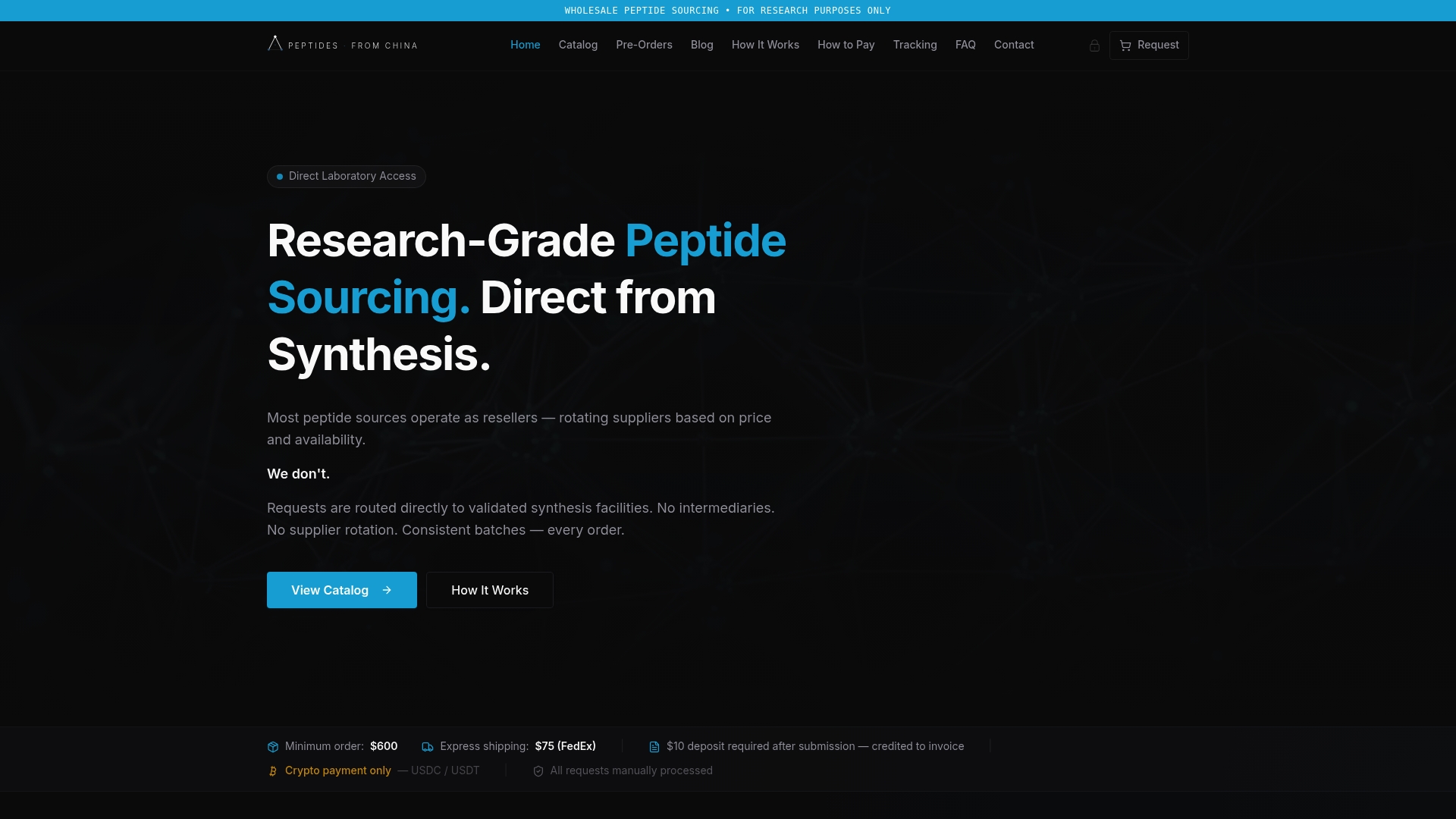
The platform’s sourcing model is built around supply chain transparency rather than reseller intermediaries. Each batch carries a COA that includes HPLC purity data, LC-MS identity confirmation, and lot traceability back to the synthesis facility. For teams running incoming COA reviews, this means the raw data needed to complete a full checklist review is available without a protracted back-and-forth with an opaque supplier.
All materials are supplied for research purposes only and are not intended for human therapeutic use. COA documentation is provided to support QA review processes, not as a substitute for independent confirmatory testing where your protocol requires it.
To review available catalog items with COA documentation, including research-grade KPV and Epithalon, submit a sourcing inquiry through the catalog. Stock confirmation and batch documentation are provided before final payment is requested.
This content is for informational and research purposes only. It does not constitute medical, legal, or regulatory advice. Confirm all applicable requirements with the relevant regulatory authority or a qualified professional before making compliance decisions.
Sources
The sources below are the primary references QA teams should consult when making or defending COA review decisions. Each is cited for a specific function in the review process.