Bypass Peptide Reseller Supply Chain: A 2026 Guide

Direct sourcing from qualified peptide manufacturers is the most reliable method to bypass peptide reseller supply chains and maintain consistent access to research-grade material. Reseller networks introduce multiple failure points: unmarked repackaging, recycled certificates of analysis (COAs), and no direct line to the synthesis facility. Procurement teams that establish direct manufacturer relationships and implement formal supplier qualification programs gain batch traceability, independent purity verification, and the documentation depth that resellers rarely provide. This guide covers the quality standards, qualification frameworks, and resilience tactics that make direct sourcing work in practice.
What are the critical quality and documentation standards when sourcing peptides directly?
Direct sourcing from manufacturers delivers peptide purity at or above 99.0% with batch-specific documentation that resellers typically cannot replicate. That purity threshold matters because research reproducibility depends on knowing exactly what is in each vial, not just what the label claims. Without batch-level data, procurement teams are buying on trust rather than evidence.
Qualified peptide suppliers in 2026 must meet five non-negotiable documentation standards. Each one closes a specific gap that reseller networks routinely leave open:
HPLC chromatograms per batch. A purity claim without the underlying chromatogram is unverifiable. Procurement teams should request the actual data file, not just the summary number on a COA.
Mass spectrometry identity confirmation. HPLC measures purity; MS confirms the molecule is what the supplier says it is. Both are required. Neither alone is sufficient.
Independent third-party COA. The manufacturer’s own lab report is not independent verification. A COA from an accredited external laboratory, with the lab’s name and accreditation number disclosed, is the standard.
Endotoxin and sterility testing. Biological peptides intended for in vitro or in vivo research require LAL endotoxin testing and sterility confirmation. These tests are detailed in sterility testing protocols and are not optional for serious research applications.
Batch tracking through vial labels and linked COAs. Every vial should carry a batch number that maps directly to a specific COA. If the numbers do not match, the documentation is generic and unreliable.
Supply-chain transparency and batch-level analytical data are the only trustworthy markers of quality in peptide sourcing. Marketing language about purity percentages means nothing without the underlying chromatographic and spectrometric data to support it. Procurement teams that accept summary claims without raw data are exposed to the same risks they were trying to avoid by leaving reseller networks.
How to establish a formal peptide supplier qualification program

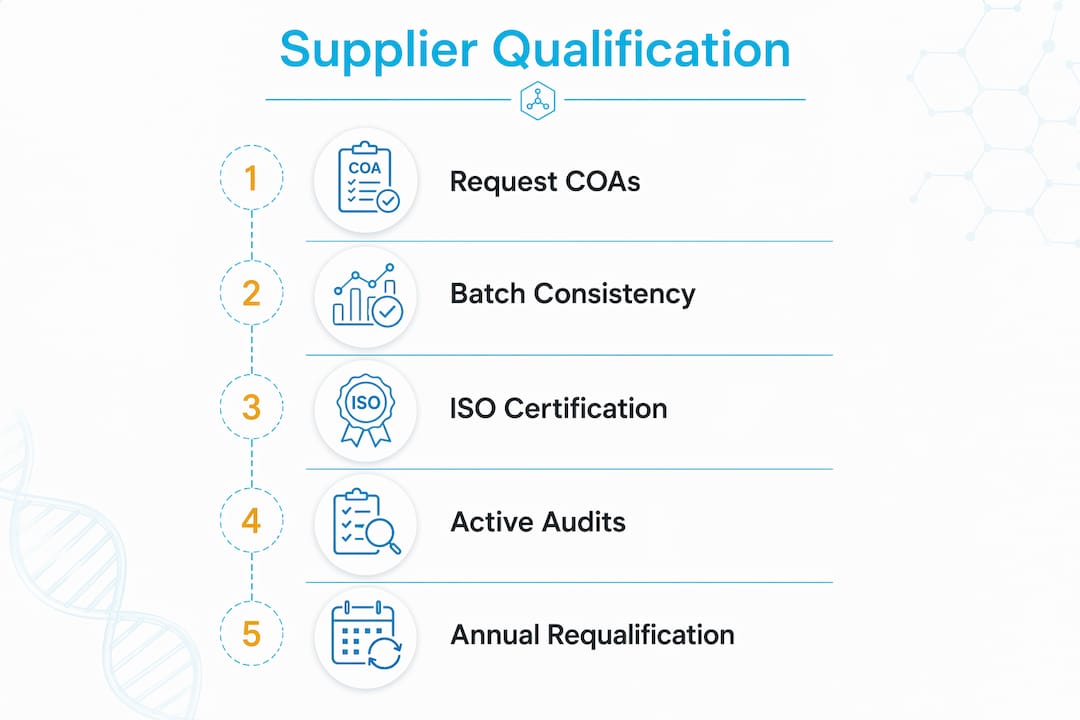
A formal supplier qualification program is the structural mechanism that lets procurement teams bypass reseller distribution permanently rather than on a case-by-case basis. Supplier qualification processes include four sequential stages: initial assessment, audit, approval decision, and ongoing monitoring. Each stage filters out suppliers who cannot meet documentation and quality requirements before they enter the active supply base.
The qualification sequence works as follows:
Risk-based supplier categorization. Not all peptide suppliers carry the same risk. Suppliers providing sterile finished products for biological research are high-risk. Raw API suppliers for non-sterile applications are lower-risk. Categorization determines audit intensity and documentation requirements before any other step begins.
Initial supplier assessment. Send a structured questionnaire covering synthesis capacity, quality management system (QMS) documentation, batch release procedures, and analytical capabilities. Request sample COAs and chromatograms from recent batches before committing to an order.
On-site or remote audit for critical vendors. High-risk suppliers require direct inspection of their synthesis facility, lyophilization equipment, and QMS records. Remote audits via video walkthrough are an acceptable substitute when travel is not feasible, but they should be supplemented with document review.
Approval decision and quality agreement. A quality agreement formalizes the supplier’s obligations: batch-specific COA delivery, notification of manufacturing changes, and right-to-audit clauses. No supplier should enter the approved vendor list without a signed quality agreement.
Ongoing monitoring and periodic re-qualification. Supplier qualification is a continuous process involving performance reviews, re-qualification audits on a defined schedule, and rapid response when a supplier notifies of process changes. Annual re-qualification is the minimum for critical suppliers.
Pro Tip: Request COAs from at least three consecutive production batches during initial assessment. Consistency across batches reveals more about a supplier’s process control than any single data point.
Ongoing supplier qualification relies on a functional QMS with ISO certification and active audits. ISO certification alone is not sufficient evidence of quality. The audit history, corrective action records, and change notification logs tell a more complete story about how a supplier actually operates.
What operational strategies build a resilient peptide supply chain?
Single-source dependency is the most common structural failure in peptide procurement. When one manufacturer experiences a production delay, a regulatory hold, or a raw material shortage, teams with no qualified backup face complete supply interruption. Procurement teams should qualify at least two secondary or tertiary backup suppliers per critical peptide to avoid this outcome.
Resilience tactics that procurement teams can implement now include:
Qualify backup suppliers before disruption occurs. Running a small-scale qualification batch annually with each backup supplier keeps them audit-ready. A supplier that has not received an order in 18 months may have changed processes, personnel, or equipment without notification.
Implement cold chain redundancy. Lyophilized peptides are stable at room temperature for short periods, but long-distance shipping requires validated cold chain logistics. Using multiple logistics partners with real-time temperature monitoring prevents a single carrier failure from compromising an entire shipment.
Use digital supply chain tracking tools. Real-time visibility into order status, shipment location, and temperature logs reduces response time when something goes wrong. Procurement teams without digital tracking are managing risk reactively rather than proactively.
Diversify supplier geography. Geopolitical risks and export regulations complicate international peptide supply chains. A supplier base spread across multiple regions reduces exposure to sanctions, customs delays, and regional manufacturing disruptions.
Coordinate across procurement, QA, and regulatory teams. Supply chain decisions made by procurement alone, without QA input on documentation standards or regulatory input on import requirements, create gaps that surface at the worst possible time.
Pro Tip: Treat annual qualification batches with backup suppliers as a fixed line item in the procurement budget. The cost of a small test order is negligible compared to the cost of an unplanned supply interruption.
Cold chain redundancy, digital tracking tools, and cross-functional coordination are the operational foundation of a supply chain that does not collapse when a single node fails. These are not advanced practices. They are baseline requirements for any procurement team managing critical research materials.
How to verify and vet peptide supply alternatives effectively
Vetting a new supplier is not a one-time event. It is a structured process that should produce documented evidence before the first commercial order is placed. The professional supplier vetting checklist covers the key verification steps, but the most common failure points are worth addressing directly.
Match vial batch numbers to independent COAs. The batch number on the vial must match the batch number on the third-party COA exactly. A mismatch indicates the COA was generated for a different production run and cannot be used to verify the product in hand.
Reject suppliers who refuse batch-specific documentation. Any supplier unwilling to provide batch-specific COAs before or at the time of shipment is operating without adequate quality controls. Generic documentation is not a substitute.
Identify recycled or generic chromatograms. A chromatogram that lacks a batch number, date, and analyst signature is likely a template rather than a real analytical result. Procurement teams should authenticate research purity by requesting the raw data file from the analytical instrument, not just a formatted PDF.
Confirm QMS credentials with audit history. ISO certification is a starting point. The audit history, corrective action reports, and change control logs reveal whether the QMS is functional or decorative.
Understand the risks of private labeling. Private labeling can break the chain of custody for quality unless the original independent batch COAs are included in the final packaging. Procurement teams sourcing through private-label intermediaries must explicitly require original third-party COAs as a contractual condition.
Only independently verified, batch-specific COAs can reliably assure peptide purity and identity. Vendor marketing claims, website purity percentages, and generic lab reports do not meet this standard. Procurement teams that accept anything less are introducing the same documentation risk they were trying to eliminate by moving away from reseller networks.
Key Takeaways
Bypassing reseller networks requires direct manufacturer sourcing, formal supplier qualification, and batch-specific documentation verified by independent third-party laboratories.
Point Details Direct sourcing sets the purity floor Manufacturers delivering ≥99% HPLC purity with batch chromatograms are the baseline for reliable procurement. Batch number matching is non-negotiable Every vial’s batch number must match the independent COA exactly; mismatches indicate recycled or generic documentation. Qualification is a continuous process Annual re-qualification audits and performance reviews prevent supplier drift from going undetected. Backup suppliers require active maintenance Qualifying secondary suppliers annually keeps them audit-ready before a disruption forces the issue. Private-label agreements need COA clauses Original third-party COAs must be contractually required in private-label arrangements to preserve traceability.
The documentation gap is the real problem
The peptide procurement field has a documentation problem that most teams underestimate until they face a failed experiment or a regulatory inquiry. I have reviewed supplier packages from dozens of sources over the years, and the pattern is consistent: the further a product moves from the synthesis facility, the thinner the documentation gets. By the time a peptide reaches a researcher through a multi-tier reseller network, the COA is often a formatted PDF with no batch number, no accredited lab name, and no raw chromatographic data. It looks professional. It is not verifiable.
The fix is not complicated, but it requires procurement teams to treat documentation review as a technical skill rather than an administrative task. Reading a chromatogram, identifying a recycled COA, and understanding what an ISO audit history actually tells you are competencies that belong in the procurement function, not just in QA. Teams that build this capability internally stop relying on supplier claims and start evaluating supplier evidence.
The other underappreciated issue is private labeling. Many procurement teams assume they are buying from a manufacturer when they are actually buying from a repackager who sources from multiple facilities and applies a single brand label. The original batch COA disappears in that process unless the buyer explicitly requires it in the contract. Requiring original third-party COAs in every private-label agreement is a one-sentence contract clause that eliminates a significant traceability risk.
— Sam Levin
How PeptidesFromChina supports direct peptide procurement
PeptidesFromChina operates as a direct-access sourcing platform connecting procurement teams with established Chinese synthesis facilities. The platform provides batch-specific COAs, independent purity verification, and documented cold chain handling for each order.
Procurement professionals and research teams can access the full peptide catalog to review available compounds, batch documentation standards, and ordering options. Each listing includes the analytical documentation framework that the procurement checklist for 2026 identifies as essential for verified sourcing. PeptidesFromChina does not operate through gray-market reseller channels. The platform’s sourcing model is built on direct facility relationships, batch traceability, and documentation that procurement teams can actually verify.
FAQ
What does it mean to bypass the peptide reseller supply chain?
Bypassing the reseller supply chain means sourcing peptides directly from the synthesis facility rather than through intermediary distributors. Direct sourcing eliminates documentation gaps and provides batch-specific COAs tied to the actual production run.
What purity standard should direct peptide suppliers meet?
Qualified peptide suppliers should deliver ≥99% HPLC purity confirmed by batch-specific chromatograms and mass spectrometry identity data. A purity claim without underlying analytical data does not meet this standard.
How often should peptide suppliers be re-qualified?
Critical peptide suppliers require re-qualification at least annually, including performance reviews and audit updates. Any supplier notification of a manufacturing process change should trigger an immediate out-of-cycle review.
How do I detect a recycled or generic COA?
A genuine batch-specific COA includes the batch number, production date, analyst signature, and the accredited external laboratory’s name and accreditation number. A COA missing any of these elements is likely generic and cannot verify the product in hand.
Why does private labeling create supply chain risk?
Private labeling breaks the chain of custody when the original third-party COA is not included in the final packaging. Procurement teams must require original batch COAs as an explicit contractual condition in any private-label sourcing agreement.